
Foot and Ankle Tendonitis
What Is Foot and Ankle Tendonitis?
Foot and ankle tendonitis occurs when a tendon becomes irritated, overloaded or injured, causing pain and sometimes affecting normal function. Tendons are strong bands of connective tissue that attach muscles to bones and help transfer the forces that allow your foot and ankle to move.
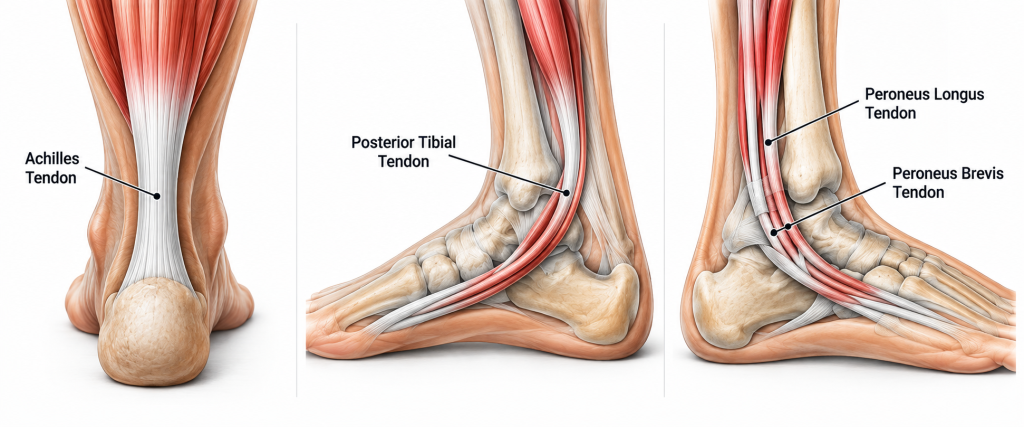
Tendon problems can occur in several areas of the foot and ankle. Common examples include the Achilles tendon at the back of the heel, the posterior tibial tendon along the inside of the ankle and the peroneal tendons along the outside of the ankle. Symptoms can develop gradually from repetitive loading or appear more suddenly following an injury or change in activity.
Although the term tendonitis is commonly used, not all persistent tendon pain is caused primarily by inflammation. Proper assessment is important to determine which tendon is involved and what may be contributing to the problem.
Common Tendons Affected in the Foot and Ankle
Several tendons in the foot and ankle can become painful or injured. The illustration below shows three commonly affected tendons, although other tendons of the foot and ankle can also be involved.
Symptoms of Foot and Ankle Tendonitis
Symptoms depend on which tendon is affected and how long the problem has been present. Pain may develop gradually or begin after an injury or increase in activity. The discomfort is usually felt along the course of the affected tendon and may worsen with walking, running, sports or other activities that load the tendon.
Common symptoms can include:
- Pain or tenderness along a tendon
- Swelling around the foot or ankle
- Stiffness, particularly after rest
- Pain that increases with activity
- Weakness or difficulty with certain movements
- Thickening or changes in the affected tendon
What Causes Foot and Ankle Tendonitis?
Foot and ankle tendon problems often develop when the amount of stress placed on a tendon exceeds its ability to recover. This can happen gradually with repetitive activity or more suddenly following an injury or a significant increase in activity.
Contributing factors may include changes in exercise or training, repetitive loading, certain sports or occupations, previous injury, footwear and the structure and mechanics of the foot and ankle. In some cases, arthritis or other medical conditions can also affect tendon health.
The cause is not always the same from one patient to another. Identifying which tendon is involved and the factors placing stress on it is an important part of developing an appropriate treatment plan.
Common Types of Foot and Ankle Tendonitis
The Achilles tendon connects the calf muscles to the heel bone and is one of the most commonly injured tendons in the lower extremity. Pain is typically felt at the back of the heel or slightly above it and may be worse with walking, running, climbing stairs or after periods of rest.
Posterior Tibial Tendonitis
The posterior tibial tendon travels along the inside of the ankle and helps support the arch of the foot. Pain and swelling may develop along the inside of the ankle or arch. As the tendon becomes weaker or damaged, the arch may gradually flatten and the position of the foot can change.
Peroneal Tendonitis
The peroneal tendons travel behind the outside of the ankle and along the outer side of the foot. They help stabilize the foot and ankle during walking and activity. Irritation can cause pain or swelling along the outside of the ankle or foot, particularly with repetitive activity or uneven surfaces.
Dealing With Foot or Ankle Tendon Pain?
Schedule an appointment with Alberta Family Podiatry to have your foot or ankle pain assessed and determine which treatment options may be appropriate for your condition. Call us at 587-355-3992 or use the text button on this page to contact our clinic.
How Is Tendonitis Diagnosed?
Diagnosis begins with an examination of the foot and ankle to determine which tendon is involved and identify the movements or activities that reproduce your symptoms. We assess the location of pain and swelling, tendon strength and function, joint movement, foot structure and the way the foot functions when standing and walking.
Depending on the tendon involved and the severity or duration of the problem, imaging may sometimes be recommended. X-rays can help assess the bones and joints, while ultrasound or MRI may be used when more detailed evaluation of the tendon is needed.
For additional information about foot and ankle tendon injuries, visit the American College of Foot and Ankle Surgeons.
Treatment for Foot and Ankle Tendonitis
Treatment for foot and ankle tendonitis depends on which tendon is affected, the severity of the injury and the factors contributing to the problem. The goal is to reduce stress on the tendon, allow it to recover and gradually restore strength and function.
Depending on the condition, treatment may include modifying activities, supportive footwear, icing, anti-inflammatory measures, bracing or temporary immobilization. Stretching and strengthening exercises may also be recommended as the tendon begins to recover.
Custom orthotics are often helpful when foot structure or mechanics are contributing to abnormal stress on the affected tendon. More persistent or severe tendon injuries may require additional treatment, and surgery may occasionally be considered when significant tendon damage is present or conservative treatment has been unsuccessful.